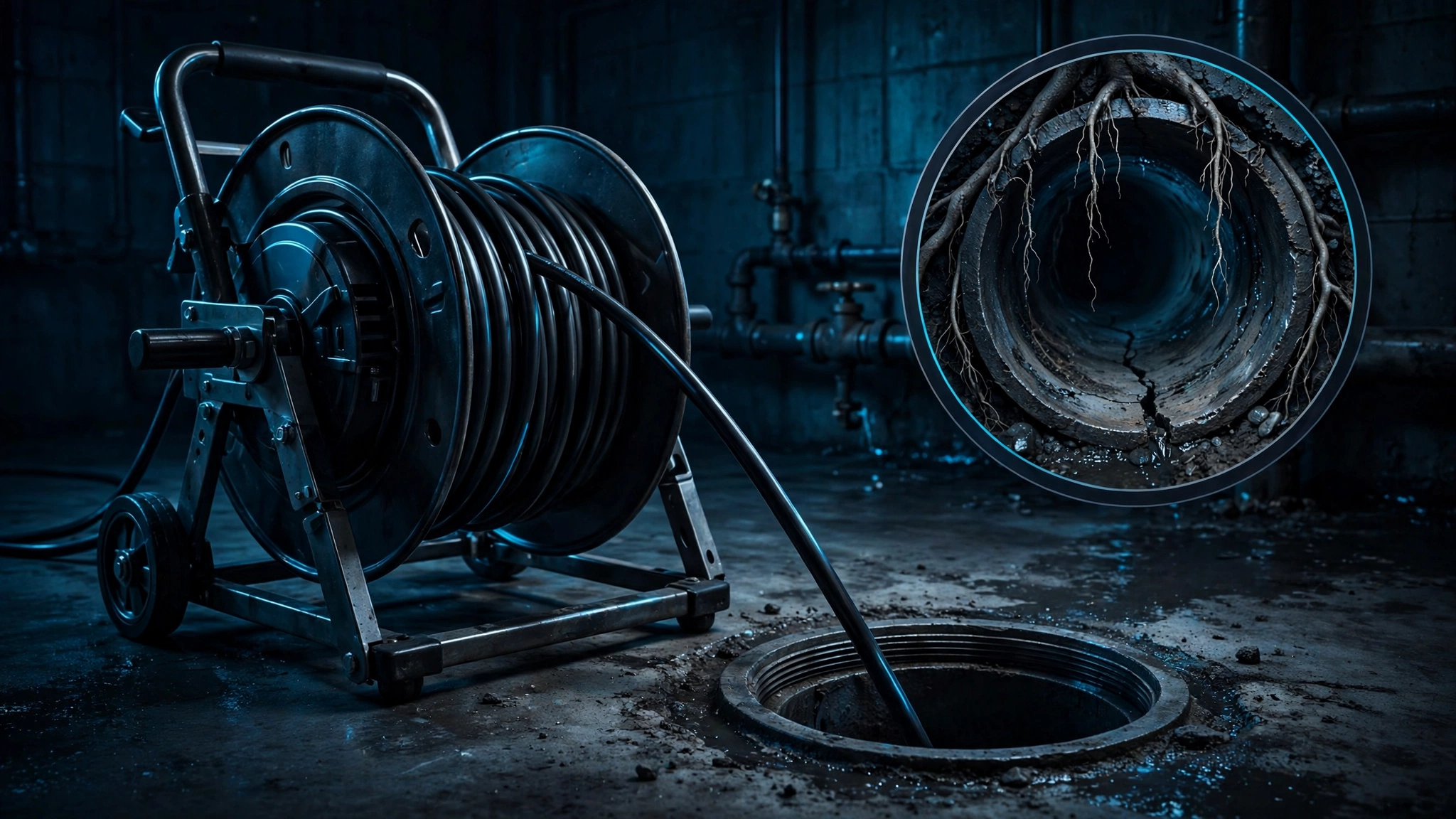
There's no substitute for seeing inside the pipe. A video camera inspection sends a high-resolution camera through your sewer or drain line, showing exactly what's in there — roots, cracks, bellies, offsets, breaks — with distance markers that tell us how far in each defect sits and a locator beacon that lets us mark it on the surface above. It's the difference between 'we think the problem is somewhere under the yard' and 'the break is 34 feet in, six feet down, right there.'
Warning signs
When to call us
Any time the plan involves digging, replacing, or buying — verify first with a camera. It's also the right call when symptoms keep recurring despite snaking or jetting, because those clear blockages but don't fix structural defects.
How we find it
A self-leveling camera on a flexible push rod travels the line from a cleanout, transmitting live video with on-screen distance footage.
The camera head emits a signal; a surface receiver tracks it so every defect gets marked on the ground with location and depth.
Defects are identified by type — roots, cracks, fractures, offsets, bellies, scale, debris — so the report describes what's actually wrong, not just 'it's bad.'
Where the camera is inconclusive (standing water hiding a hairline crack, for example), hydrostatic testing or smoke testing provides the second opinion.
Our process
- 1Access check
We locate your cleanout — the access point that makes a camera survey straightforward. (No cleanout? We'll explain the options honestly.) - 2Full-length survey
The camera runs the entire accessible line while you watch the live feed with us. - 3Defect marking
Each significant defect is located from the surface and marked — distance in, depth down, position in the yard. - 4Video & report
You get the recorded video, marked locations, and a plain-English report describing each defect and what it means. - 5Next-step guidance
Spot repair, lining, or replacement — we'll explain what the findings suggest so you can talk to contractors from knowledge, not fear.
Expect to watch the whole thing live — roots, cracks, and bellies are unmistakable on screen, and there's something deeply satisfying about seeing the actual problem. Most residential laterals are fully surveyed in one visit. Expect honest narration: we'll tell you what's a real problem, what's cosmetic, and what's normal aging.
Honest limitations
Cameras show condition, not pressure integrity — a hairline defect can look fine on camera but fail a hydrostatic test. Standing water, heavy scale, or debris can hide defects; badly obstructed lines may need cleaning before the camera can pass, and we'll tell you that rather than force it. We diagnose and locate; repair is your contractor's work.
Sandy & Utah context
Wasatch Front laterals run through clay and cobble soils with a frost depth around 30 inches — lines typically sit 48 to 60 inches deep. Tree roots in our soils aggressively target leaking joints, and 'bellies' (sagging sections that trap solids) are a documented local pattern. Older Sandy neighborhoods with original clay, concrete, or Orangeburg-era laterals are the highest-risk stock. Local plumbers uniformly recommend camera verification before any sewer excavation — it's the area's standard of care, and any quote to dig without a camera survey deserves a question.