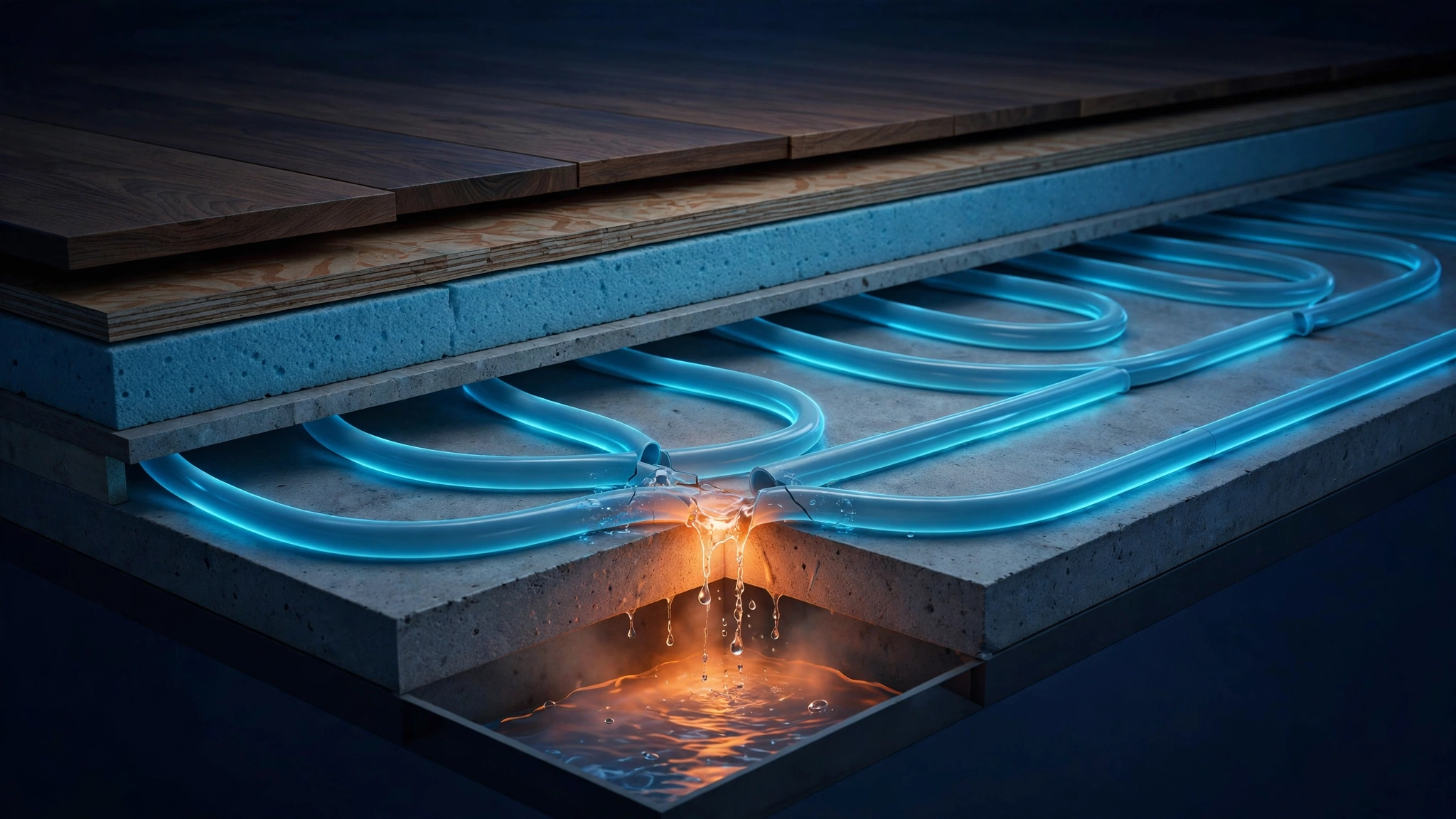
Most Utah homes heat with forced air — but the homes with hydronic or radiant floor heating, and the ones with boilers, face a problem forced-air homes never see: a closed heating loop that keeps losing pressure. You top up the system, the pressure falls again, and somewhere in hundreds of feet of tubing or piping, water is escaping where you can't see it. Finding it means understanding how these systems fail — and using thermal imaging and pressure isolation to narrow a whole-house loop down to one zone, then one spot.
Warning signs
When to call us
If your hydronic system or boiler needs topping up more than occasionally, the leak is real and worth finding — continuous fresh-water top-ups also introduce oxygen that corrodes the system from the inside, so delay has a compounding cost. Call when the pressure pattern is consistent, not just after one top-up.
How we find it
The loop is divided zone by zone; the zone that won't hold pressure contains the leak. This turns a whole-house search into a single-zone search.
Infrared cameras see the heat signature of active hydronic tubing — a leaking zone shows a different thermal pattern than intact ones, and the anomaly narrows the location.
For leaks under slabs or in walls, listening equipment can pick up the sound of escaping water in the same way it does for domestic leaks.
For stubborn cases where the loop is deep or inaccessible, a safe tracer gas introduced into the isolated zone surfaces above the leak point.
Our process
- 1System review
We map the system: boiler or heat source, manifolds, zones, and what's accessible — so testing is planned, not improvised. - 2Baseline pressure test
The whole system is tested first to confirm the leak and its rate. - 3Zone isolation
Zones are isolated one by one until the leaking zone is identified. - 4Pinpoint within the zone
Thermal imaging and acoustic methods narrow the zone's leak to a specific area. - 5Documented finding
You get the zone, the location, and what's next — for your heating contractor to access and repair.
Expect a process that respects how these systems work — we won't drain your whole system speculatively or cut into floors without evidence. Most investigations narrow to one zone in a single visit; pinpointing within the zone depends on access and construction, and we'll be honest about confidence levels.
Honest limitations
We locate the leak; heating contractors perform the repair. Some leaks in deeply embedded radiant tubing can only be narrowed to a zone rather than an exact point — we'll tell you which outcome we've reached. We don't service boilers themselves; if the pressure loss is at the boiler (expansion vessel, relief valve, heat exchanger), we'll identify that and refer you to a heating professional.
Sandy & Utah context
Utah is furnace country — forced air dominates, and hydronic or radiant heating is the premium exception, found in higher-end builds, bench-area custom homes, and properties with snowmelt driveways. That means local expertise in hydronic leak detection is thin; most general plumbers rarely see these systems. Salt Lake-area thermal specialists do offer hydronic leak detection, which confirms the demand exists. If your Sandy home has radiant floors or a boiler, you need someone who understands closed-loop diagnostics — not just domestic plumbing.