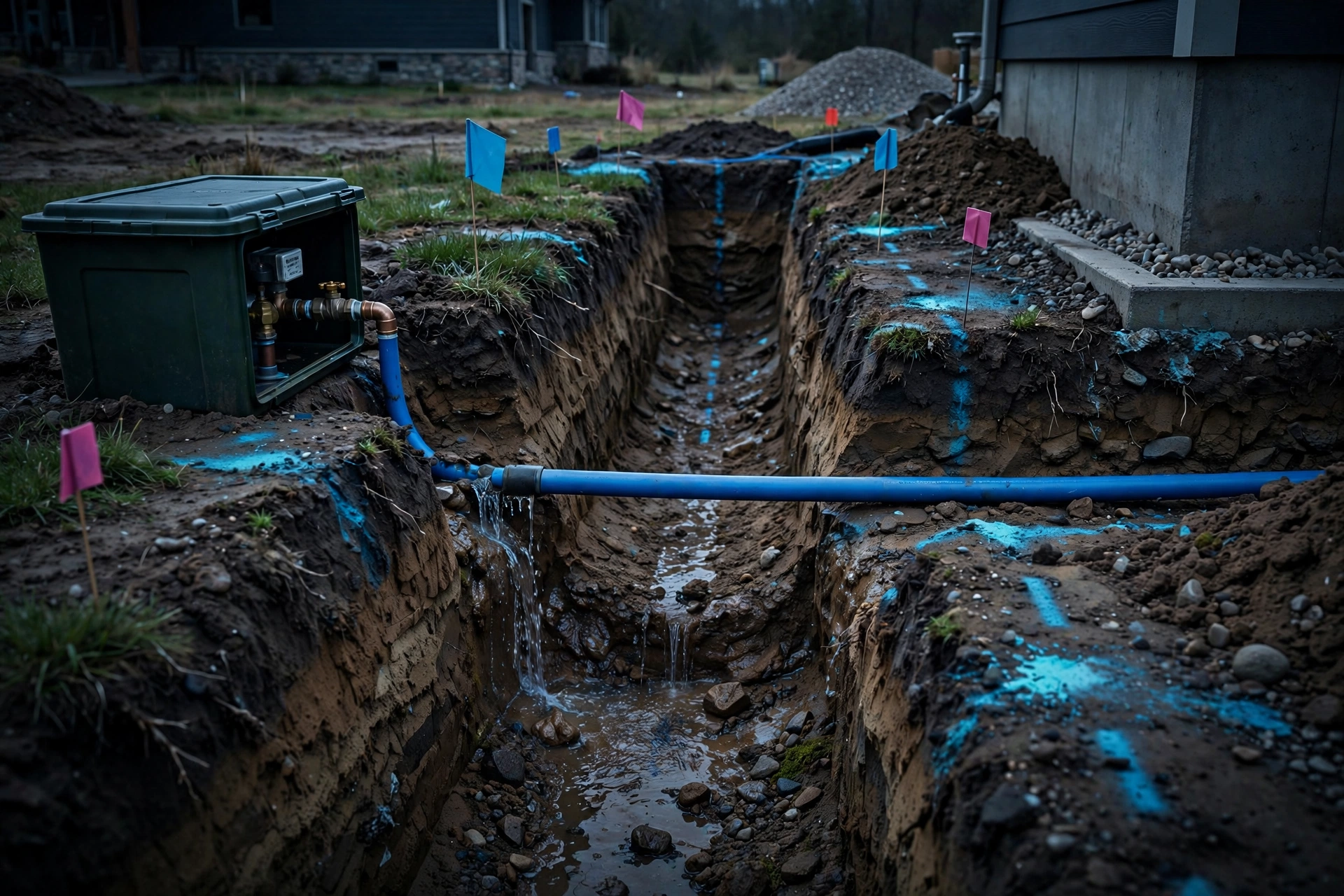
The water service line — the pipe running from Sandy City's meter vault to your home — is your responsibility as the homeowner, and when it leaks underground, the symptoms can be baffling: a soggy strip of lawn that never dries, water pooling where it hasn't rained, a hissing sound near the meter, or a bill that climbs month after month. Because the line is buried, most plumbers' instinct is to dig and hope. Ours is to locate first: we trace the line's exact path, then use acoustic listening or tracer gas to pinpoint the break — so excavation happens in one spot, not along your entire front yard.
Warning signs
When to call us
If the meter test points to the service line, or if you have soggy ground along the likely pipe path, get the leak located before anyone digs. Knowing the exact point of failure turns a full-trench replacement quote into a targeted repair — and gives you the documentation to make an informed decision.
How we find it
These are two different jobs and we do both. Line locating maps where the pipe runs using electromagnetic tracers. Leak detection finds where it's broken using acoustic or tracer-gas methods. You need the first to make sense of the second.
Ground microphones pick up the sound of pressurized water escaping the pipe, loudest directly above the break.
For lines where acoustic is inconclusive — deep burial, noisy soil conditions — we introduce a safe hydrogen-nitrogen blend and detect where it surfaces above the leak.
Testing the service line independently confirms it's the leaking segment before location work begins.
Our process
- 1Meter & symptom verification
We confirm the service line is the suspect with meter tests and a walk of the property. - 2Trace the line
Electromagnetic locating maps the pipe's path from meter vault to foundation entry, marked on the surface. - 3Acoustic sweep
Listening equipment follows the marked path; the leak's sound signature peaks above the break. - 4Confirm & mark
Tracer gas or a second acoustic pass confirms the point. We mark it and photograph the location for your records. - 5Repair-ready report
You get the line path, the leak point, and depth estimate — everything a repair contractor needs for a single-spot excavation.
Expect paint marks on the ground showing your pipe's path and one marked leak point — not a trench across your yard. Most residential service lines are located in a single visit. We'll also tell you the line material we observed, which matters for repair planning (older galvanized or polybutylene lines sometimes warrant replacement rather than spot repair).
Honest limitations
We locate the leak; excavation and repair are done by your plumber or utility contractor. Very deep lines or lines under concrete driveways can be harder to pinpoint precisely — we'll tell you the confidence level of every mark. Sandy City owns the line up to the meter vault; everything from the meter to your home is yours.
Sandy & Utah context
Sandy City's own guidance is clear: the water service line from the meter vault to the home belongs to the homeowner. Along the Wasatch Front, service lines run through clay and cobble soils with a frost depth around 30 inches — lines are typically buried 48–60 inches deep. Freeze-thaw movement, shifting soils during dry periods, and aging pipe materials (galvanized, polybutylene in older Sandy neighborhoods) are the common local failure modes. Irrigation cross-connections and tree roots near the line path are worth checking too.