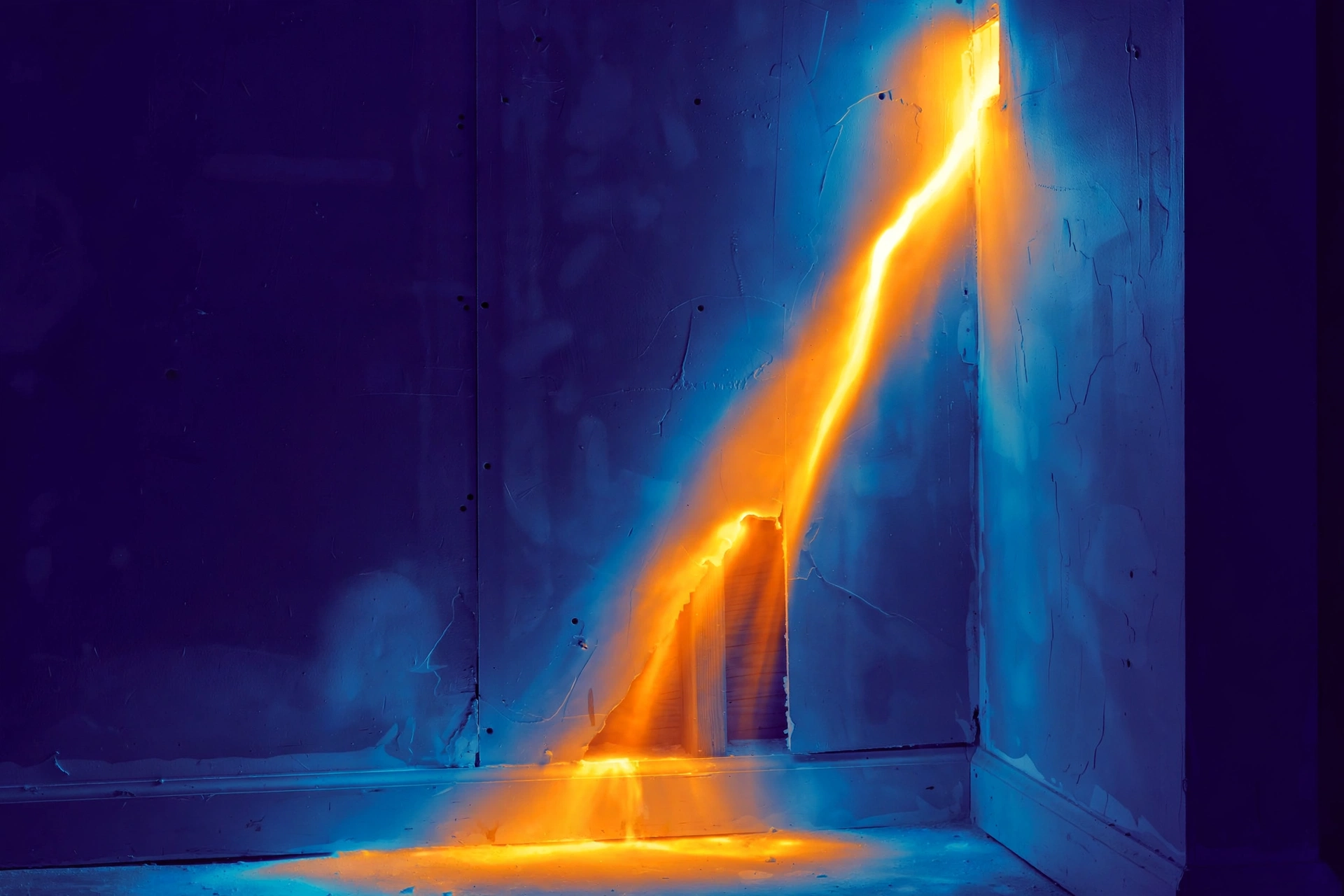
An infrared camera doesn't see water — it sees temperature. And that distinction is exactly what makes it powerful: a hot-water leak paints a warm plume across a slab or wall that the camera reads clearly; active moisture evaporating from a surface cools it, showing as a cold anomaly. Used by someone who understands building science, thermal imaging reveals hidden leaks behind drywall, under flooring, and above ceilings without opening anything. Used carelessly, it's just pretty colors. Here's how we use it properly — and where its limits are.
Warning signs
When to call us
Thermal imaging earns its place when the leak involves temperature differences — hot-water lines, active evaporation, or heated systems. For cold-water leaks in temperature-stable environments, it's one tool among several, and we'll pair it with acoustic or pressure methods rather than rely on it alone.
How we find it
A calibrated thermal camera scans surfaces, rendering temperature differences as color. The operator reads patterns — plumes, streaks, gradients — not just colors.
Every thermal anomaly gets verified with pin or pinless moisture meters. The camera finds suspects; the meter convicts them.
Good thermal work sometimes means creating temperature difference — running hot water, or scanning during heating cycles — to make the leak's signature stand out.
Thermal plus acoustic is the classic combination: thermal shows the area, acoustic pinpoints within it. Neither works alone as well as both work together.
Our process
- 1Baseline scan
We scan the suspect area to establish normal thermal patterns before drawing conclusions. - 2Anomaly identification
Patterns that don't match the baseline — unexpected warmth, evaporative cooling — get flagged and mapped. - 3Moisture verification
Meters confirm whether each anomaly is actually wet or just thermally interesting (sun loading, air currents, and insulation gaps all create false positives). - 4Source tracing
Confirmed moisture is traced to its highest point or warmest origin — water travels, so the stain is rarely the source. - 5Documented findings
Thermal images with moisture readings, marked on the surface where it matters for repair access.
Expect to see the images yourself — thermal anomalies are visual and intuitive once explained. Expect us to verify with a meter before calling anything a leak; a camera-only diagnosis is a guess with nice colors.
Honest limitations
Thermal imaging works best with temperature difference — cold-water leaks in stable conditions, leaks behind highly reflective surfaces, or very slow seeps can be thermally invisible. It also can't see through all materials equally, and it shows surface temperature, not water itself. That's why every finding gets meter-confirmed, and why we never sell thermal as a standalone magic answer.
Sandy & Utah context
In Sandy, thermal imaging pulls double duty: domestic leak detection and hydronic/radiant heating diagnostics (the same camera maps radiant tubing and finds its leaks). Local competitors universally list thermal imaging as a core method, and at least one Salt Lake-area specialist focuses on infrared diagnostics specifically — so it's an expected capability here. Our freeze-thaw climate also means thermal is useful for finding where winter has compromised insulation or created condensation issues that mimic leaks.