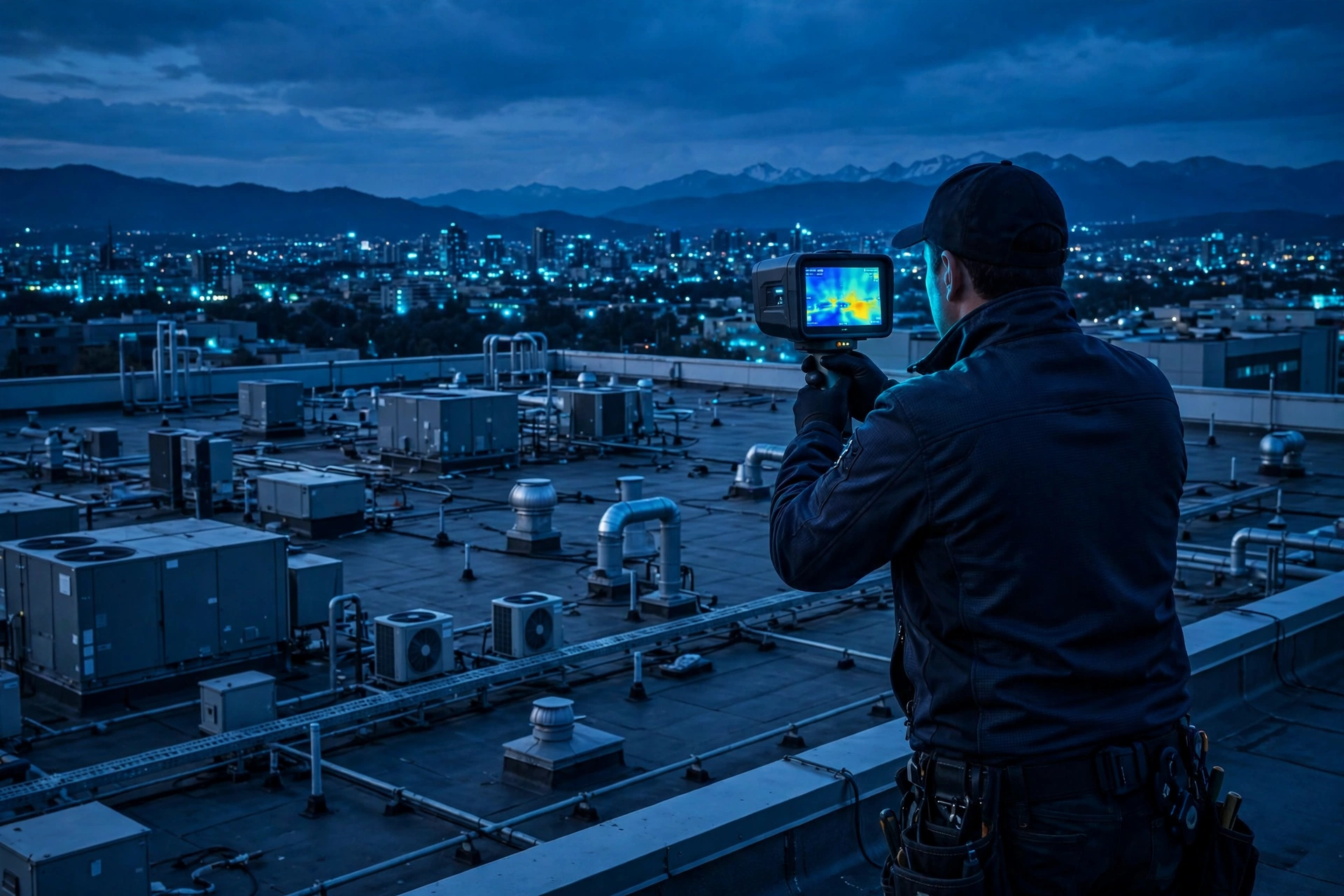
A flat roof rarely fails all at once — it fails slowly, as water infiltrates the membrane and saturates the insulation beneath, invisibly, for years. By the time a ceiling stain appears inside, the wet area is often far larger than the stain suggests, and the repair bill reflects it. A roof moisture survey finds that trapped water before it becomes a crisis: infrared thermography, nuclear moisture gauges, and electric field vector mapping reveal exactly where insulation is wet — so maintenance, warranty claims, and replacement decisions are based on evidence, not guesswork.
Warning signs
When to call us
When a flat or low-slope commercial roof is aging, showing symptoms, approaching a warranty milestone, or being evaluated for purchase or capital planning. A survey every few years on a large roof is cheap compared to replacing insulation that could have been saved — or replacing a whole roof when only 15% is wet.
How we find it
After sunset, wet insulation releases stored heat more slowly than dry insulation — an infrared camera maps the difference across the entire roof surface. The industry-standard method (ASTM C-1153) for full-coverage surveys.
Neutron-based gauges detect hydrogen (water) in the roof assembly directly — effective on reflective or ballasted roofs where infrared struggles.
Handheld meters measure moisture in the upper assembly; useful for spot verification and smaller roofs.
For pinpointing actual membrane breaches: an electric field is applied across the membrane, and the vector mapping traces current flow to the exact puncture. Often paired with surveys to go from 'wet area' to 'entry point.'
A quality-assurance method for new or exposed membranes — a charged broom swept over the surface arcs at pinholes and breaches. Used during installation QA and forensic follow-up, per ASTM D7877.
Survey findings are verified with small core cuts that confirm moisture content physically — the standard that turns a thermal image into a defensible report.
Our process
- 1Roof review
We document the roof: membrane type, age, penetrations, drainage, and history — because survey interpretation depends on construction. - 2Evening infrared survey
After sunset, the thermal camera maps the full roof surface, marking wet-insulation patterns. - 3Gauge verification
Nuclear or capacitance readings confirm the thermal findings at representative points. - 4Breach pinpointing
Where the entry point matters, vector mapping or spark testing traces the actual membrane defect. - 5Moisture map & report
You get a roof plan marked with wet areas, core results, and prioritized recommendations — repair, monitor, or replace, by section.
Expect an evening or night visit — infrared roof surveys happen after sunset when the thermal contrast develops. Expect a roof plan with clearly marked wet areas and percentages, not just a verbal 'it's wet in places.' Expect honest scope: a survey finds wet insulation; pinpointing the exact entry point is a follow-on step we'll recommend when it matters.
Honest limitations
A moisture survey maps wet insulation — it doesn't by itself identify every membrane breach; that's what vector mapping and cores are for. Surveys need the right conditions (dry weather, proper thermal differentials), so scheduling depends on weather. We diagnose and document; roofing contractors perform the repairs. Findings reflect conditions at survey time — roofs change, which is why periodic surveys beat one-time snapshots.
Sandy & Utah context
Sandy's commercial corridors — State Street, 9000 South, the Shops at South Town area — carry plenty of flat and low-slope roofs now decades into their service life. Utah's climate is hard on membranes: intense UV, freeze-thaw cycling, and snow loads that pond and stress drainage. Infrared roof surveying is an established service in the Salt Lake Valley, so building owners here can get it done locally — and given our weather, they should, before small breaches become saturated assemblies.