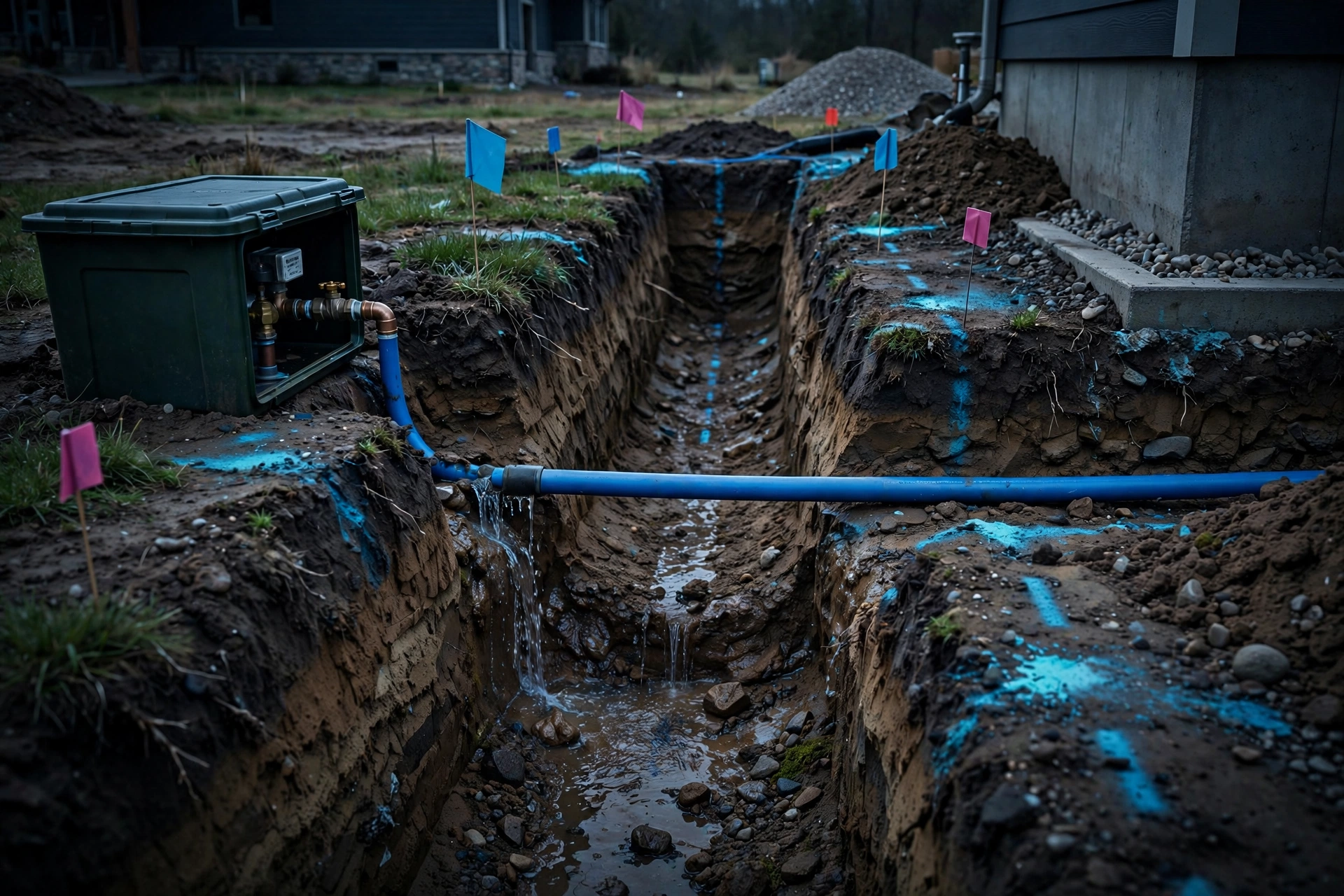
Before you hunt for a leak, you prove there is one — and pressure testing is how. Static testing pressurizes the water-supply side and watches for gauge drops; hydrostatic testing plugs and fills the drain/sewer side and watches the water level. Together they answer the fundamental question about each half of your plumbing: does it hold? It's the unglamorous, decisive diagnostic that everything else builds on — and the test that settles 'is it the supply lines or the drains?' before a dollar is spent on location work.
Warning signs
When to call us
Whenever the existence or location of a leak is disputed — between you and a contractor, between supply and drain theories, or before committing to invasive investigation. It's also the right verification after any significant plumbing repair.
How we find it
The supply system is isolated at the meter or main, pressurized, and monitored. A dropping gauge proves a supply-side leak; a holding gauge rules it out.
The drain/sewer section is plugged and filled with water. A falling level proves the drain side leaks — even when a camera couldn't see the defect.
Large systems are divided — hot vs. cold, upstairs vs. down, branch by branch — so a failing test narrows to a section, not just 'somewhere.'
Proper testing uses calibrated gauges and controlled pressure — not a glance at the hose bib. Documented readings are part of every report.
Our process
- 1System review
We map what's testable: supply zones, drain sections, available isolation points. - 2Supply static test
The pressurized side is tested first in most investigations — it's where meter-movement mysteries get solved. - 3Drain hydrostatic test
When drains are suspect, sections are plugged, filled, and monitored. - 4Zone narrowing
Failing sections are subdivided until the leak is isolated to the smallest testable zone. - 5Documented results
Gauge readings, hold times, and the isolated zone — written up for your records or your contractor.
Expect gauges, numbers, and patience — pressure testing is methodical by nature. A proper test takes time (a quick glance proves nothing), and we'll explain what each reading means as we go. Expect a definitive answer about which half of your plumbing is sound and which isn't.
Honest limitations
Pressure testing proves a leak exists and narrows its zone — it doesn't pinpoint the exact point; that's what acoustic, thermal, or tracer-gas work does next. Some systems can't be cleanly isolated due to missing valves or access, which limits how far we can narrow; we'll tell you that upfront. Testing also requires the system to be in testable condition — active major breaks need repair before meaningful testing.
Sandy & Utah context
In Sandy, pressure testing is the standard precursor to slab and service-line investigations — local specialists describe isolation testing as the first step before acoustic or thermal work begins. Our freeze-thaw climate makes post-winter testing worthwhile: spring is when freeze damage to supply lines and hose bibs shows up as pressure loss. And for the area's older housing stock with mixed pipe materials, zone isolation is especially valuable — it keeps the investigation focused instead of condemning an entire system.